
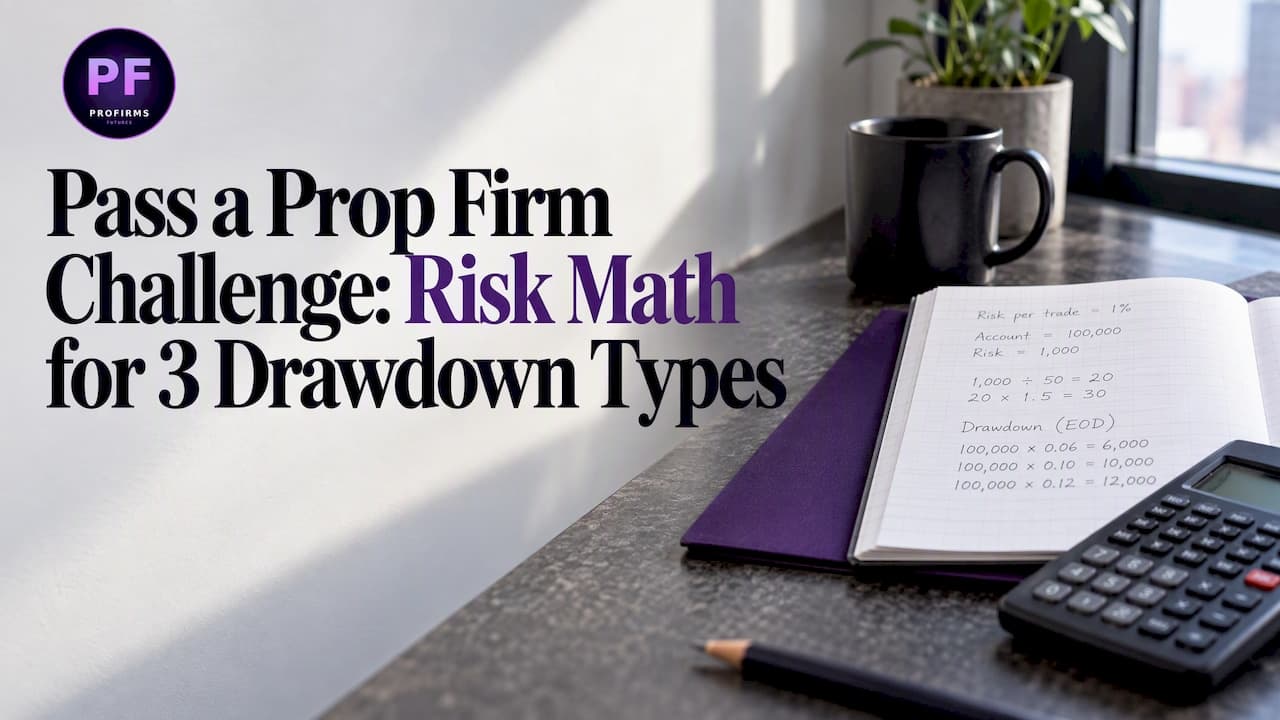
You pass a prop firm challenge by protecting the drawdown first and sizing every trade off a worksheet, not a feeling. That means reading the rulebook before you click buy, calculating your exact per-trade risk, setting a personal daily stop tighter than the firm’s, picking one repeatable strategy, and running mock sessions until the plan is boring. Slower, consistent progress beats rushing the profit target every time.
TL;DR:
Risk 0.25% to 1% of equity per trade, start at 0.25% with a new strategy, and resize weekly as your balance changes.
Set your personal daily stop at half the firm’s limit, stop after two consecutive losses, and pause before major news releases.
Check whether your drawdown is static, end of day trailing, or intraday trailing; the last can move your floor during a session.
Rehearse 10 to 20 mock session days on your intended platform, track entries and outcomes, and test slippage before paying for an evaluation.
Table of Contents
-
What the Challenge Actually Tests: Rule Types and Evaluation Models
-
In-Session Risk Controls and Habits That Keep Your Evaluation Alive
-
Five Strategy Patterns That Consistently Pass Under Challenge Rules
-
Typical Failure Modes and Immediate Fixes to Avoid Restarting
-
Pre-Launch Checklist and How to Simulate the Evaluation for Practice
-
Timeline and Pacing: Translate Percent-Per-Day Targets Into Realistic Pass Windows
-
How Profirmsfutures’ Features Support the Article’s Risk-First Method
-
Start Here: Try Practice Trading and Run Your First Mock Evaluation
What the Challenge Actually Tests: Rule Types and Evaluation Models
A prop firm evaluation looks like a trading contest, but it functions as a risk-management exam. The profit target is the easy part. The daily loss limit and the maximum drawdown are what actually decide whether you get funded, and according to one breakdown of first-attempt pass rates, only about 10 to 15% of traders clear a challenge on their first try, with most failures coming from blown drawdown limits rather than a missed profit target.
The structure you choose changes how you should behave. A 1-step evaluation compresses everything into one pass window, so your per-trade risk needs to be tighter because there is no second phase to absorb a rough week. A 2-step model gives you a verification phase after the initial pass, which means you can afford a marginally larger buffer in phase one since phase two will re-test your discipline anyway.
Drawdown type matters just as much as the number of steps. Three common structures show up across the industry, and each one rewards a different style of session management, as detailed in this comparison of drawdown systems:
-
Static drawdown: the floor never moves, so a strong week gives you real breathing room for the weeks that follow.
-
End-of-day trailing drawdown: your floor resets based on your daily close, which rewards locking in gains and never letting a winning day turn into a losing one.
-
Intraday trailing drawdown: the floor can move against you mid-session, which punishes holding through a reversal after a spike and demands tighter stops on strong runs.
Our own breakdown of these mechanics in Prop Firm Rules: The Five Core Risk Controls That Trip Traders goes deeper into how each type interacts with daily loss caps.
Beyond drawdown, most rulebooks include a minimum trading days requirement (so you cannot pass in one lucky session), a profit target expressed as a percentage of starting balance, and in some cases consistency rules that cap how much of your total profit can come from a single day. Consistency rules exist to filter out traders who got there with one oversized gamble rather than a repeatable process.
Put these pieces together and the challenge reveals its real design: it converts ordinary trading variance into a pass or fail outcome. A strategy with a positive edge can still fail a challenge if the sizing behind it is loose enough that one bad sequence breaches the daily or max drawdown limit before the edge has a chance to play out. Surviving the rules, not predicting the market, is the actual skill being tested.
Do the Math: Position-Sizing Worksheets and Worked Examples
Before you place a single trade, convert the firm’s daily loss limit and max drawdown into a dollar figure you risk per trade. Practitioner guidance commonly points to 0.25% to 1% of account equity per trade, as outlined in this strategy guide for passing evaluations, which gives you enough runway to survive 10 to 20 losing trades in a row before you approach a daily limit.
Statistic callout: Practitioner guides consistently recommend risking 0.25% to 1% of equity per trade as the buffer needed to survive a losing streak without breaching a daily loss cap. That range is the single most important number in this entire article: it is the difference between a bad week and a restart.
Here is the worksheet, step by step:
-
Find your firm’s daily loss limit and max drawdown in dollars, not percent. Write both numbers down before anything else.
-
Pick your per-trade risk percentage from the 0.25% to 1% range. Newer traders or anyone trading a brand-new strategy should start at the conservative end.
-
Multiply account size by your chosen percentage to get your dollar risk per trade. A 1% choice on a $50,000 account is $500 per trade.
-
Divide that dollar risk by your stop distance in ticks, pips, or points to get your position size. If your stop is 20 ticks on a futures contract worth $5 per tick, $500 divided by $100 ($5 x 20 ticks) gives you 5 contracts.
-
Cross-check against the daily loss limit. If three consecutive losses at that size would breach the daily cap, reduce size until a four or five-loss sequence is survivable.
-
Recalculate weekly as your account balance changes, since risk sized off a stale balance drifts away from the rule math that actually protects you.
Worked examples make this concrete. Say a 25K account carries a $500 daily loss limit. These are illustrative figures to show the math, not fixed sizing rules for every instrument.
The same framework shifts slightly by instrument. Futures contracts have fixed tick values, so your sizing math is a clean multiplication. CFDs quote risk in pips or points depending on the instrument, and spreads widen during news, so build a few extra ticks of buffer into your stop distance before you calculate size. Crypto moves in much larger percentage swings intraday, which means the same dollar-risk target usually means a meaningfully smaller position size than you would use on a major forex pair or equity index future.
Running these numbers through a simulation before trading live adds another layer of confidence. Backtestify’s guidance on percentile simulations shows how running your sizing plan through hundreds of simulated sequences reveals how many consecutive losses your worksheet can actually absorb, which is far more useful than guessing.
Build a simple template you reuse every session: account balance, daily loss limit, chosen risk percentage, dollar risk per trade, planned stop distance, resulting position size. Fill it in before the market opens, not while you are already in a trade.
In-Session Risk Controls and Habits That Keep Your Evaluation Alive
The worksheet sets your size. These habits keep you inside the lines once the session starts.
If the firm allows a $1,000 daily loss, you stop trading for the day once you are down $500. This single rule, recommended across multiple practitioner strategy guides, creates a buffer between a rough session and an account-ending one, and it removes the temptation to “trade your way back” on a day that has already gone sideways.
Pair that with stop-first execution: place your stop loss order the moment you enter, before you even confirm the target. A pre-session checklist helps make this automatic rather than optional, covering:
-
Confirm the day’s economic calendar and mark any high-impact releases.
-
Verify your worksheet numbers match today’s account balance.
-
Check that your platform connection and data feed are stable before the open.
-
Set a hard cap on trades per day, commonly three to five depending on your strategy’s frequency.
That trade cap matters more than it sounds. Overtrading is one of the fastest routes to a blown daily limit, and a simple “two losses, stop” rule interrupts the emotional spiral before it compounds. Two consecutive losing trades in a session is your signal to close the platform, not to size up on the third attempt to recover.
News handling deserves its own line item. Major releases like NFP or an FOMC statement can move futures indices by 100 to 200 points or more within seconds, a swing size commonly cited as a top cause of sudden daily loss breaches. The fix is scheduling, not prediction: check an economic calendar every morning, flatten positions or step away from the screen 15 to 30 minutes before any high-impact print, and resume only once volatility has settled back to a normal range.
Pro Tip: Treat your personal daily stop as non-negotiable the same way you’d treat a doctor’s appointment: it happens whether you feel like it or not.
Five Strategy Patterns That Consistently Pass Under Challenge Rules
A challenge rewards one repeatable setup executed with discipline over five clever ideas executed inconsistently. These five patterns fit comfortably inside a conservative sizing plan.
Trend pullback. Confirm the higher timeframe trend direction, wait for price to pull back to a moving average or prior support and resistance level, then enter on the first sign of resumption. A stop just beyond the pullback low or high keeps risk tight, and a target at the prior swing high or a fixed multiple of your stop distance (commonly 1.5 to 2 times) keeps the trade mechanical rather than emotional.
Breakout-retest. Instead of chasing a breakout the moment it happens, wait for price to break a clear level and then retest it from the other side. Entering on the retest gives you a much smaller stop than entering on the initial breakout candle, which directly lowers your required position size and your exposure to a false breakout reversal.
Mean reversion inside defined sessions. In range-bound conditions, fading moves back toward a session’s average price works well, but only with a tight risk cap, since a true breakout will blow through a mean-reversion stop quickly. This pattern fits best in lower-volatility sessions where ranges tend to hold rather than during the opening hour of a major market.
Session-based bias. Not every hour of the trading day behaves the same way. Many traders find the first one to two hours after a major exchange opens offer the cleanest directional moves, while the mid-session lull tends to produce choppy, low-conviction price action that is harder to size confidently. Picking one or two sessions to focus on, rather than trading all day, naturally limits your trade count and supports the two-losses-stop rule from the previous section.
Low-frequency setups with a strict filter. Whichever pattern you choose, add one non-negotiable filter, such as only trading in the direction of the higher timeframe trend, or only taking the first signal of the session. Fewer, higher-quality trades reduce the odds of an overtrading-driven daily loss breach and make your results easier to track in a journal.
Across every one of these patterns, the same explicit rule applies: no new entries during high-impact news releases. Schedule around the calendar rather than trying to trade through it, and treat a scheduled print the same way you would treat a market holiday: a reason to step back, not a reason to size up on a guess.

Typical Failure Modes and Immediate Fixes to Avoid Restarting
Most challenge failures trace back to a small number of repeatable mistakes. Catching them early is cheaper than a second evaluation fee.
-
One oversized trade blows the daily limit. A single trade sized beyond your worksheet number can erase days of progress in minutes. The fix is mechanical: never place a trade without checking size against your written worksheet first, and close the position the instant your personal daily stop is hit rather than waiting to see if it recovers.
-
A trailing drawdown reverses after a big win. A strong session can feel like safety, but on an end-of-day or intraday trailing system, that same win raises your floor and shrinks your future cushion. Staged sizing, where you reduce position size after an unusually large winning trade rather than increasing it, protects the gain instead of giving it back.
-
Emotional cascades after a loss. A loss triggers a slightly larger next trade to “make it back,” which triggers a bigger loss, which triggers an even larger next trade. The two-losses-stop rule exists specifically to interrupt this pattern before it reaches the daily limit.
-
Slippage and platform outages during volatile windows. A stop order that should have filled at your planned price can slip several ticks during a fast market or a brief outage. Precheck your platform’s stability before high-volatility sessions, and keep a manual fallback plan, such as a phone number or backup device, in case your primary setup drops connection mid-trade.
Pre-Launch Checklist and How to Simulate the Evaluation for Practice
Running a structured rehearsal before you pay for an evaluation meaningfully raises your odds of passing on the first attempt, since it exposes execution issues before they cost you a restart fee.
Work through this checklist before launch:
-
Read the full rulebook and mark the exact drawdown method (static, end-of-day trailing, or intraday trailing), the news and hold policy, and the weekend position rules.
-
Confirm your account’s legitimacy and fee structure, using a resource like this prop firm legitimacy checklist if anything in the terms feels unclear.
-
Run 10 to 20 mock session days using your exact worksheet sizing and personal daily stop, treating each mock trade as if real money were on the line.
-
Build a minimal trade journal tracking entry, stop, target, outcome, and the reason for the trade, so you can measure your actual edge rather than guessing at it.
-
Test execution quality, slippage, and spreads on the same platform and instruments you plan to trade live, not a different demo environment.
| Checklist item | What it confirms |
|---|---|
| Rulebook marked for drawdown type | You know exactly which drawdown rules govern your sizing |
| 10 to 20 mock days completed | Your worksheet sizing survives real losing streaks |
| Trade journal in place | You can measure edge instead of relying on memory |
| Execution tested on live platform | Slippage and spread won’t surprise you mid-challenge |
Timeline and Pacing: Translate Percent-Per-Day Targets Into Realistic Pass Windows
A steady pace of 0.5% to 1% profit per trading day is a practical target that reaches a typical 8 to 10% profit threshold in roughly 8 to 20 trading days, depending on how consistently the daily gains compound and how many flat or losing days show up along the way.
Statistic callout: A pace of 0.5% to 1% per day reaches an 8 to 10% profit target in roughly 8 to 20 trading days, which gives you enough cushion to absorb a losing day without abandoning the plan.
Pushing for a larger daily target feels faster, but it comes with diminishing returns once variance enters the picture.
Build in decision rules for adverse variance before you need them. If you hit your personal daily stop three sessions in a row, pause trading for a day and review your journal rather than pushing through on the fourth day. If a single week produces a drawdown approaching half of the firm’s maximum limit, that is a signal to cut position size in half until the equity curve stabilizes, not a signal to trade more aggressively to recover it.
How Profirmsfutures’ Features Support the Article’s Risk-First Method
Everything in this guide works better with the right account structure behind it. We built our funded account model around the same survival-first thinking: an easy-to-understand end-of-day drawdown system with no consistency rules, which lets you apply the worksheet math above without a hidden rule quietly shrinking your buffer mid-session.
A few specific features line up directly with what this guide recommends:
-
We let you keep a high percentage of your earnings from the very first payout, with no tiered scaling required before you see that split.
-
We enable instant practice trading the moment you sign up for an evaluation, so the 10 to 20 mock days this guide recommends can start today instead of after a waiting period.
-
We run transparent payouts based on clear thresholds, with no hidden fees and no platform switch once you get funded, which you can see detailed on our payout proof page.
-
We publish ongoing education on rule mechanics, including a full breakdown of end-of-day drawdown and the five core risk controls that trip up most traders.
The worksheet, the mock runs, and the personal daily stop from earlier sections are designed to work inside exactly this kind of rule structure: simple enough to plan around, transparent enough to trust.
Why Discipline Beats Clever Strategies in Evaluations
I’ve written out five strategy patterns in this guide, and honestly, any one of them can pass a challenge or fail one. The variable that decides which outcome you get is never the setup. It’s whether you stuck to the worksheet on the day your account was down $400 and every instinct said size up on the next trade to get even.
Process beats cleverness here. Journal every trade, even the boring wins that followed the plan exactly, because that journal becomes the evidence that your edge is real rather than lucky. Once you’re funded, keep the same sizing discipline through your first few payout cycles before you even think about scaling size, since the behaviors that got you funded are the same ones that keep you funded.
Use practice trading as a reinforcement loop, not a one-time rehearsal. Run the worksheet until it’s automatic, then run it some more.
Start Here: Try Practice Trading and Run Your First Mock Evaluation
You’ve got the worksheet, the rules, and the strategy list. Here’s how to put them to work this week with Profirmsfutures: open instant practice trading the moment you sign up, no waiting period involved, and run your first mock evaluation against the exact sizing numbers from your worksheet.

-
Open an instant practice account and confirm your worksheet numbers against the real end-of-day drawdown rules on our tracker.
-
Run 10 mock session days using your personal daily stop set at 50% of the firm limit, exactly as outlined earlier in this guide.
-
Once your mock results hold up, choose the eval size that matches your worksheet from our full lineup of evaluation and funded accounts, keep that same 50% personal daily stop in place for your first paid attempt, and keep your sizing honest from day one.
We keep our rules simple on purpose: a clear end-of-day drawdown that never trails and no consistency requirements, so the math you practiced on a mock account carries over cleanly once real capital is on the line.
FAQ
What percentage should I risk per trade in a prop firm challenge?
Most practitioner guides recommend risking 0.25% to 1% of account equity per trade, which gives you enough buffer to survive a run of 10 to 20 losing trades before approaching a daily loss limit. Newer traders or anyone testing a new strategy should stay at the conservative end of that range.
How long does it typically take to pass a prop firm evaluation?
A steady pace of 0.5% to 1% profit per trading day reaches a typical 8 to 10% profit target in roughly 8 to 20 trading days. Pushing for a faster pace increases the position size needed to hit daily targets, which eats into your drawdown buffer.
What causes most prop firm challenge failures?
Most failures come from breaching a daily loss limit or maximum drawdown rule rather than failing to reach the profit target, according to practitioner data on first-attempt pass rates. Oversized trades, trading through news releases, and emotional overtrading after a loss are the most common triggers.
What is end-of-day drawdown and how is it different from trailing drawdown?
End-of-day drawdown resets your risk floor based on your account balance at the daily close, rather than moving against you in real time during the session. We explain the full mechanics of how this structure differs from an intraday trailing system that can reduce your buffer mid-trade.
Should I avoid trading during news events while in a challenge?
Yes. Major releases like NFP or an FOMC announcement can move futures indices by 100 to 200 points or more within seconds, a swing size commonly identified as a top cause of sudden daily loss breaches. Checking an economic calendar each morning and stepping away from new entries 15 to 30 minutes before a high-impact print avoids this risk entirely.