
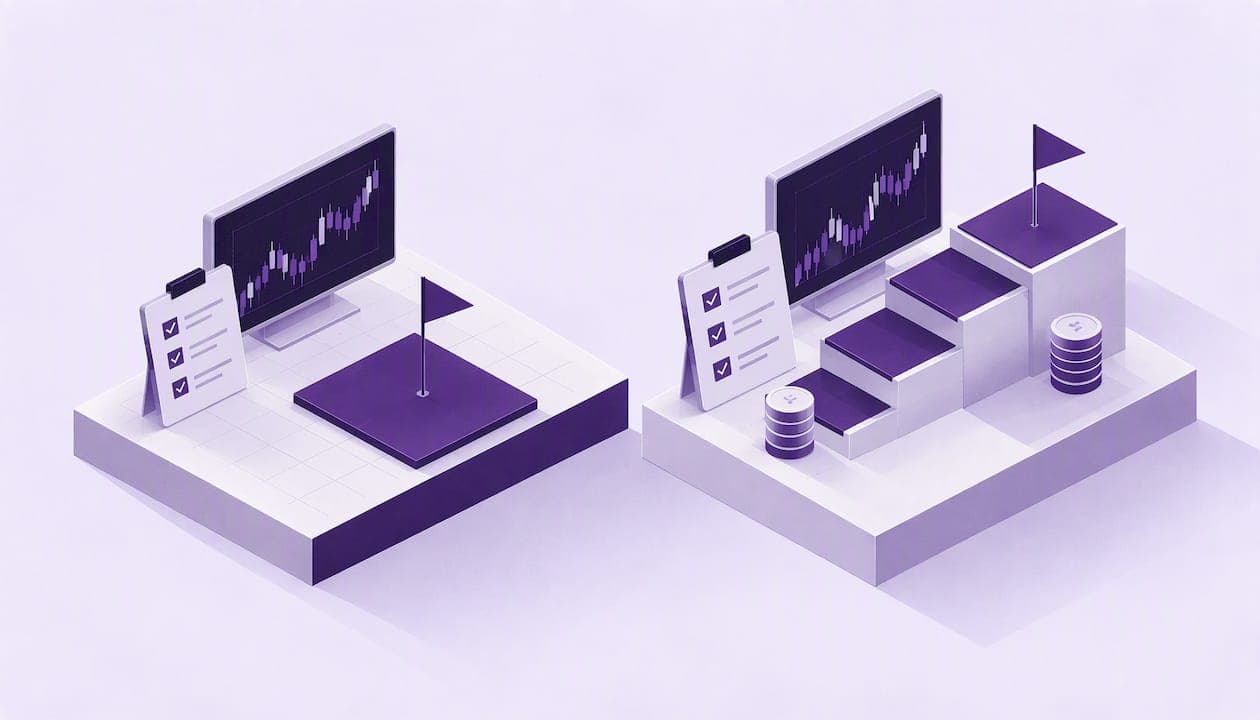
TFF and FTMO both sell a way to trade a funded account after you pay a fee, but they are built differently. FTMO runs a two-phase challenge with percentage-based loss limits. TFF is a futures-focused firm, so its rules sit in dollar-based futures terms. The right pick depends on what you trade, how you size positions and how you want to be paid. Below is a side-by-side framework, the FTMO rules we could verify, a checklist for reading TFF's current rulebook, and where Profirms fits if you trade futures.
TL;DR
- FTMO's standard challenge has two phases: a 10% target, then 5%, with a 5% daily loss limit and a 10% overall loss limit (EdgeFlo's FTMO rules summary).
- TFF is a futures-oriented comparison point, so check its drawdown type, contract limits and payout buffer on its own rulebook before paying.
- "Funded" rarely means your own live brokerage account. Read the agreement to see what you actually get (The Broker Bench).
- Profirms charges a one-time fee, keeps no consistency rule, and you keep 90% of every payout from the first payout. Accounts are simulated.
Table of Contents
- What you are really comparing
- FTMO at a glance
- TFF: what to check before you pay
- Drawdown: the rule that decides most accounts
- Profit targets and time pressure
- Payouts: where firms differ most
- Platforms, instruments and trading styles
- Country eligibility and terms
- Which should you choose?
- Where Profirms fits
- FAQ
- Sources
What you are really comparing
Both firms sit in the same category: you pay a fee, trade a simulated account under a rulebook, and if you meet the conditions you can receive payouts based on simulated gains. An explainer from The Broker Bench makes the same point: evaluations involve real fees, simulated balances and potentially real payouts, so "funded" does not automatically mean a personal live brokerage account (The Broker Bench). Its advice is practical: read the agreement instead of inferring ownership of capital from marketing.
That framing matters more than any logo. Before you compare TFF and FTMO, compare five things:
- How the loss limit is calculated.
- What the profit target and time pressure look like.
- Which instruments and platforms you can use.
- How and when you can take a payout.
- What the total cost is once you count resets and repeat attempts.
FTMO at a glance
FTMO uses the classic two-step model. According to EdgeFlo's 2026 summary of the rules, the standard challenge works like this (EdgeFlo):
| Rule | FTMO standard challenge |
|---|---|
| Phase 1 profit target | 10% |
| Phase 2 (verification) target | 5% |
| Maximum daily loss | 5%, counting closed trades, open positions, commissions and swaps |
| Maximum overall loss | 10% (equity cannot fall below 90% of the starting balance) |
| Minimum trading days | 4 per phase |
| Time limit | None |
| Fee | Refunded with the first profit split payout |
Two things stand out. First, the limits are percentages of the starting balance, so a $100,000 account has a $5,000 daily limit and a $10,000 overall limit. Second, the daily limit counts open positions, so a floating loss can put you at the limit before you close anything.
FTMO is also built around forex and CFD-style instruments, with a long track record. Its model suits traders who like a lot of room on total loss and are comfortable passing two phases. Confirm current fees, split, and country eligibility on FTMO's own site, because those change.
TFF: what to check before you pay
TFF is a futures-focused firm, and futures firms tend to write rules in dollars and contracts rather than percentages. We did not verify TFF's current figures from its own rulebook for this article, so we will not quote numbers that could be stale. Instead, use this checklist on its rules page before you buy.
- Drawdown type. Is the max-loss floor static, end-of-day trailing, or intraday trailing? An intraday trailing floor moves up with your open profit and can end an account on a spike you never closed.
- Contract limits. How many minis and micros can you hold, and does the limit scale as you gain?
- Consistency rules. Is there a rule capping how much of your total profit can come from one day? In an evaluation this can force you to keep trading after you have hit your target.
- Minimum trading days. Do you need to trade a set number of days before a payout?
- Payout buffer. Must you build a cushion above the starting balance before you can withdraw? What is the minimum payout and how often can you request one?
- Profit split. Is it the same from the first payout, or does it step up later?
- Fees. Is there a monthly subscription, a data fee or an activation fee once you pass?
Write the answers in a notes file. Do the same for FTMO. The firm whose answers match how you trade is the right one, regardless of brand.
Drawdown: the rule that decides most accounts
Most failed evaluations end on the loss limit, not the profit target. EdgeFlo's summary even calls the daily loss limit the rule that ends the most FTMO challenges (EdgeFlo). So read this part twice.
Percentage limits on closed and open results (FTMO model). You get a fixed daily allowance and a fixed total allowance. They are easy to calculate. They also count floating losses, so a position that dips deeply and then recovers can still breach the daily limit.
Trailing drawdown (common in futures). The floor follows your equity high. Intraday versions raise the floor during the session as open profit grows, so you can be stopped out of the account after giving back unrealized gains. End-of-day versions only reset the floor at the close.
Non-trailing end-of-day drawdown (Profirms). The loss threshold is locked at the previous day's close. During a session you can lose, recover and keep trading without the floor moving against you. We never trail the max-loss floor intraday. For a deeper look, see our guide to end-of-day drawdown and distance to threshold, or the broader piece on the five core risk controls that trip traders.

A quick worked example
Take a $50,000 account with a $2,000 loss allowance. You open the day at the floor-locked level. You are down $1,200 at midday, then trade back to flat by the afternoon. Under a rule that locks the floor at the prior close, that recovery is fine because the floor never moved. Under a percentage daily limit that counts open positions, a $1,200 dip would also be fine in this case, but a limit set at $1,000 would have ended the day at the dip. The point is not that one structure is always kinder. It is that the same trade can pass under one rulebook and fail under another, so match the rule to your style.
Profit targets and time pressure
FTMO's standard path has two targets (10%, then 5%) and no time limit, but you do need at least four trading days in each phase (EdgeFlo). That means two rounds of risk before you reach a funded stage, and two sets of days where one bad week can reset you.
For futures, firms often use a single-step evaluation with a dollar target. Check TFF's target against its loss allowance. A useful ratio is target divided by max loss. A target that is large relative to the allowance forces you to size up, and sizing up is how accounts breach.
If you want to turn those numbers into a plan, our article on risk math for three drawdown types walks through position sizing against each structure. Our look at prop firm pass rates is a useful reality check on how few evaluations convert.
Payouts: where firms differ most
A payout policy has four moving parts: the split, the timing, the minimum and the conditions.
- Split. The share of profit you keep. Ask whether it applies from the first payout.
- Timing. Weekly, biweekly, on demand or daily.
- Minimum and cap. Some firms set a minimum request or cap early payouts.
- Conditions. Buffers, minimum days and consistency tests can delay a payout even when your balance is higher.
FTMO's fee is refunded with the first profit split payout, according to the EdgeFlo summary (EdgeFlo). Confirm the current split and payout schedule on FTMO's pages. For TFF, use the checklist above. Our guide to reading payout thresholds shows how buffers and minimums change what you take home in practice.
Platforms, instruments and trading styles
The instrument decides a lot. If you trade index futures like NQ or ES, a futures firm's contract-based limits are a natural fit. If you trade forex pairs, metals and CFDs, a percentage-based CFD model like FTMO's is a more natural fit. Check three practical points on each firm's pages:
- Which platforms are supported, and whether charts and data are included.
- Whether news trading, holding over the weekend and automated strategies are allowed.
- Whether hedging is restricted. Our summary of hedging rules at prop firms shows what is typically allowed and banned.
Day traders should also look at how the loss limit treats a volatile open. Scalpers care about commissions being counted in the daily limit, as FTMO's rule does (EdgeFlo).
Country eligibility and terms
Before you pay any firm, check whether your country is accepted, what identity checks apply before a payout, and what the refund terms are. Terms change, so read the current page on the day you buy, not a review from last year. Our checklist, seven checks before you pay a prop firm, covers the questions to ask, and the no-monthly-fees checklist covers hidden charges.
Which should you choose?
Use the matrix below as a starting point.
| If you... | Lean toward |
|---|---|
| Trade forex or CFDs and want wide percentage limits | FTMO's two-phase model |
| Trade index futures with contracts | A futures-focused firm such as TFF, after you verify its rulebook |
| Want no consistency rule and a floor that never trails intraday | Profirms |
| Want a lower one-time entry cost for futures | Compare the fee tables side by side, including resets |
The honest answer for many traders is to price the full path: fee, the likelihood of a reset, and what you keep after the split. Our comparison of drawdown and consistency in an FTMO matchup shows how to do that arithmetic.
Where Profirms fits
If you trade futures and want simple rules, Profirms is built for that. Here is what we offer:
- One-time fee. Profirms charges a one-time fee. There is no subscription and no activation fee.
- 90% of every payout. You keep 90% of every payout from the first payout.
- End-of-day drawdown that never trails intraday. The threshold locks at the previous day's close.
- No consistency rule and no minimum trading days.
- Simulated accounts. Evaluation and funded accounts are simulated, and no profits are promised. Trading carries risk of loss.
- Practice trading and free charts on the Profirms terminal.
Futures pricing, as published:
| Account | Evaluation | Funded | Daily payout |
|---|---|---|---|
| 25K | $40 | $220 | $60 |
| 50K | $60 | $330 | $90 |
| 100K | $100 | $449 | $150 |
We also offer CFD and crypto accounts. See the CFD rules and crypto rules pages for targets and limits.
Profirms is not a broker and is not regulated. Our trading platforms are in final checks, and logins are emailed as each account is set up. Every order is fully refundable until its login is delivered, per our refund policy. Ready to compare? See the Profirms accounts and pricing.

FAQ
Is TFF cheaper than FTMO?
The fees depend on account size and the program you pick, and both change. Compare the current fee tables on each firm's site, and include the cost of a reset, since a second attempt can double your spend. FTMO's fee is refunded with the first profit split payout, according to a summary of its rules.
Which has the easier drawdown rule?
It depends on your style. FTMO uses a 5% daily and 10% overall loss limit, with the daily figure counting open positions. Futures firms often use a dollar floor that may trail. Check whether the floor trails intraday, because that is the harder version to manage.
Are the accounts real money?
Typically no. Evaluation accounts at prop firms are simulated, and payouts are based on simulated results under the firm's agreement, as The Broker Bench explains. The same is true at Profirms: evaluation and funded accounts are simulated.
Does Profirms charge a monthly or activation fee?
No. Profirms charges a one-time fee, with no subscription and no activation fee. You keep 90% of every payout from the first payout.
Sources
Recommended
- Payout Thresholds in Prop Firms: How to Read Them
- Prop Firm Rules: The Five Core Risk Controls That Trip Traders
- Prop Firm Fees Explained: What Getting Funded Really Costs
- Funded Account Withdrawal Methods: How Payouts Get Paid
Risk disclosure: Trading involves substantial risk of loss and is not suitable for every investor. Profirms runs simulated evaluation and funded trading programs, is not a broker-dealer or futures commission merchant and does not provide investment advice. Hypothetical or simulated performance results have inherent limitations, and no representation is made that any account will achieve profits or losses similar to those shown. Past performance is not indicative of future results.