
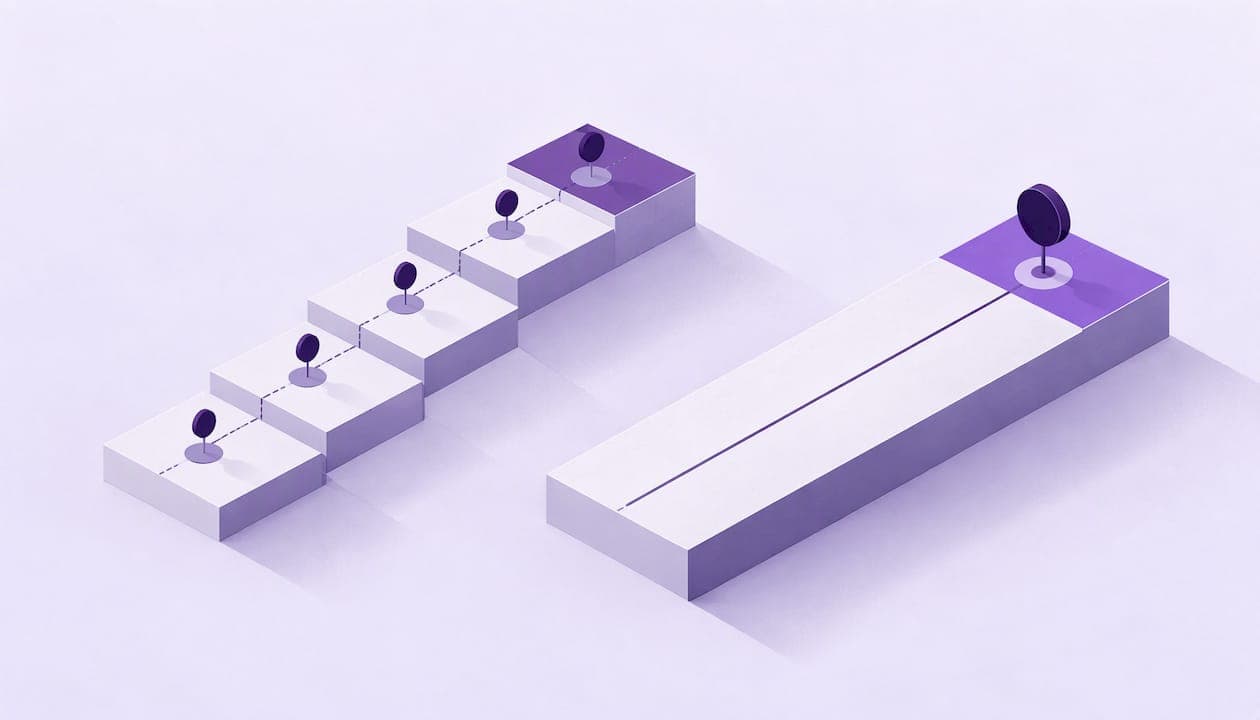
A no consistency rule prop firm lets you keep and withdraw a big winning day without first proving that your profits were spread evenly. At Profirms there is no consistency rule and no minimum trading days. You pay a one-time fee, with no subscription and no activation fee, and you keep 90% of every payout from the first payout. Evaluation and funded accounts at Profirms are simulated, and trading always carries risk.
This guide explains what a consistency rule is, how firms apply it, which other rules still matter once it is gone, and how to compare accounts before you buy.
TL;DR
- A consistency rule caps how much of your total profit can come from one day or one trade. Breaking it can block a payout or a pass.
- "No consistency rule" does not mean "no rules." Drawdown type, daily limits, news restrictions and payout conditions still decide how you trade.
- Profirms has no consistency rule and no minimum trading days. Its max-loss floor is end-of-day and never trails intraday.
- Profirms charges a one-time fee only, and you keep 90% of every payout from the first payout. Accounts are simulated, and no profit is promised.
- Every Profirms order is fully refundable until your login is delivered.
Table of Contents
- What a consistency rule is
- Who benefits from having no consistency rule
- No consistency rule is not no rules
- How to compare no consistency rule prop firms
- How Profirms handles it
- Which account fits your style
- Start with practice trading
- Trade the rulebook, not just the headline
- FAQ
- Sources
What a consistency rule is
A consistency rule limits how concentrated your profit can be. The exact wording differs by firm, but the idea is the same. If one day or one trade makes up more than a set share of your total profit, the firm treats the result as not consistent.
The usual consequences:
- You cannot pass the evaluation yet.
- Your payout request is held or denied.
- You must keep trading until the share falls under the limit.
That last point is the one traders feel most. CryptoSlate notes that consistency rules effectively turn a fast-earned profit into an obligation to keep trading, which can force you to change your risk management to meet the firm's payout conditions.
A simple example
Say a firm caps any single day at a set percentage of total profit. You have a plan that waits for one clean setup a week. You hit your profit target in one session. Under a consistency rule, that one session may be too large a share of the total, so you would have to trade more days, at more risk, to dilute it. Under no consistency rule, the target is the target.
The percentage and the way a firm calculates it (best day against total profit, or best trade against total profit) vary, so read the rulebook of any firm you consider.
Who benefits from having no consistency rule
The rule is friction for some trading styles and almost invisible for others.
- Selective traders. If you take fewer, higher-conviction trades and sit out slow sessions, a rule that rewards even daily output works against your plan.
- News and event traders. Profit often arrives in one or two sessions around a release.
- Day traders who want daily withdrawals. Waiting for a profit distribution to look "balanced" slows access to payouts.
- Newer traders. Fewer hidden conditions make it easier to know what you are being measured on.
If you trade small and steady every day, a consistency rule may never touch you. Even then, a simpler rulebook is easier to plan around.
No consistency rule is not no rules
This is where most traders get caught. When a firm drops the consistency rule, other controls still decide whether you keep the account. Check each of these first. Our guide to the five core risk controls that trip traders covers the basics.
Drawdown type
There are three common designs: a trailing drawdown that follows your peak, a static one fixed to your starting balance, and an end-of-day drawdown that resets once per session. The type changes how much room you have during a trade. Our risk math for three drawdown types shows how each one plays out when you size positions.
At Profirms, the max-loss floor is set from the previous day's close. It never trails intraday, so a winning trade does not pull your floor up behind you. You can also recover losses within a single session without penalty.
Daily loss and daily profit limits
A daily loss limit pauses trading. A drawdown limit can end the account. They are different things, as explained in daily loss limits and drawdown. Some firms also cap daily profit, which acts like a consistency rule by another name. Our piece on daily profit caps and resets shows how to calculate the limit.
News and hedging restrictions
Many firms restrict trading around major releases or ban certain hedging. These rules are separate from consistency. See news trading rules to check first and what hedging rules allow and ban.
Payout thresholds
A firm without a consistency rule may still require a minimum balance or minimum profit before a withdrawal. That is a payout threshold. Learn to read one in payout thresholds in prop firms.
How to compare no consistency rule prop firms
Use the same checklist for every firm, including ours. Put the answers side by side before you pay.
| Criterion | What to look for | Profirms |
|---|---|---|
| Consistency rule | Stated plainly as absent in the rulebook | None |
| Minimum trading days | None, or a small fixed number | None |
| Fee structure | One-time or recurring; any activation or reset fee | One-time fee, no subscription, no activation fee |
| Drawdown | Trailing, static or end-of-day; whether it moves intraday | End-of-day, never trails intraday |
| Profit split | Share you keep and whether it changes by payout | 90% of every payout from the first payout |
| Account type | Evaluation, instant funded, daily payout | Eval, Funded and Daily accounts |
| Markets | Futures, CFDs, crypto | Futures, CFDs and crypto |
| Account status | Simulated or live capital | Simulated |
Two cautions apply whatever firm you choose. First, confirm that "no consistency rule" applies to every stage and every account type, because some firms apply it in one phase and not another. Second, check whether the rule differs by market or region, since futures, CFD and crypto products often have separate rulebooks.
Questions to ask before checkout
- Is the consistency rule absent in the evaluation and in the funded stage?
- Does the drawdown move intraday, and from what level is it set?
- Are there daily profit caps, minimum trading days or payout thresholds?
- What is the full cost: one-time, monthly, activation or reset fees?
- What share of each payout do I keep, and does it change over time?
- Is the account simulated or live, and what is the refund policy?
We publish answers to these in our rulebook and on our payouts and terms sections, so you can read them before you order.
How Profirms handles it
We built the rulebook around fewer surprises.
- No consistency rule. No cap on how much of your profit can come from one day or one trade.
- No minimum trading days.
- End-of-day drawdown. The max-loss floor is locked at the previous day's close and never trails intraday.
- One-time fee. No subscription and no activation fee.
- 90% of every payout, from the first payout.
- Simulated accounts. Evaluation and funded accounts are simulated, and nothing here promises profit.
- Refund. Every order is fully refundable until your login is delivered. See the refund policy.
Our platforms are in final checks. Logins are emailed as each account is set up.
Futures, CFD and crypto rules
Each market has its own rule page with targets, limits and payouts. Read the futures rules, the CFD account rules and the crypto account rules for the product you plan to trade.
Which account fits your style
Prices below are one-time fees as published on our site. There is no monthly charge.
Futures accounts
| Account | Size | One-time fee |
|---|---|---|
| Eval | 25K | $40 |
| Eval | 50K | $60 |
| Eval | 100K | $100 |
| Funded | 25K | $220 |
| Funded | 50K | $330 |
| Funded | 100K | $449 |
| Daily | 25K | $60 |
| Daily | 50K | $90 |
| Daily | 100K | $150 |
- Eval suits you if you want the lowest entry cost and are comfortable proving your approach first.
- Funded is the instant funded option, for traders who want to skip the evaluation stage.
- Daily accounts are built for day traders who want daily profit withdrawals.
CFD and crypto accounts
| Account | Size | One-time fee |
|---|---|---|
| CFD 2-Step | 5K | $39 |
| CFD 2-Step | 25K | $149 |
| CFD 2-Step | 100K | $449 |
| CFD 1-Step | 10K | $79 |
| CFD 1-Step | 25K | $169 |
| CFD 1-Step | 100K | $499 |
| CFD Instant | 10K | $229 |
| CFD Instant | 25K | $499 |
| Crypto 2-Step | 10K | $49 |
| Crypto 1-Step | 25K | $129 |
| Crypto Instant | 25K | $189 |
Every one of these is a simulated account.
Start with practice trading

Before you buy, you can practice. Our free charts and trading terminal include replay and risk tools, so you can test your sizing against an end-of-day drawdown before you pay a fee.
When you are ready, pick the size and type that match your plan. One-time fee, 90% of every payout from the first, no consistency rule, and a full refund until your login is delivered.

See every account and its price on the Profirms pricing page.
Trade the rulebook, not just the headline
A missing consistency rule helps most when it comes with a risk plan. Size positions against your end-of-day floor, not your hopes for the session. Our risk management plan for funded accounts walks through position sizing and daily stop rules.
When you read any firm's payout claims, look for verifiable evidence. We explain how in verifying payout proof.
FAQ
What does a no consistency rule prop firm mean?
It means the firm does not cap how much of your total profit can come from one day or one trade. You can reach a target or request a payout without spreading profit across days. Other rules, such as drawdown and daily limits, can still apply.
Does Profirms have a consistency rule or minimum trading days?
No. Profirms has no consistency rule and no minimum trading days. The max-loss floor is end-of-day and never trails intraday. Accounts are simulated, and trading always carries risk.
What does Profirms charge, and what share of payouts do I keep?
Profirms charges a one-time fee for each account, with no subscription and no activation fee. You keep 90% of every payout from the first payout. Orders are fully refundable until your login is delivered.
Can I withdraw profits daily?
Profirms offers Daily accounts built for daily payouts, priced at $60, $90 and $150 for the 25K, 50K and 100K sizes. Check the payouts section for the current conditions.
Sources
Recommended
- Prop Firm Rules: The Five Core Risk Controls That Trip Traders
- Pass a Prop Firm Challenge: Risk Math for 3 Drawdown Types
- TFF vs FTMO: Rules, Costs and Payouts Compared
- Drawdown and Consistency: Funding Pips vs FTMO for Active Traders
Risk disclosure: Trading involves substantial risk of loss and is not suitable for every investor. Profirms runs simulated evaluation and funded trading programs, is not a broker-dealer or futures commission merchant and does not provide investment advice. Hypothetical or simulated performance results have inherent limitations, and no representation is made that any account will achieve profits or losses similar to those shown. Past performance is not indicative of future results.